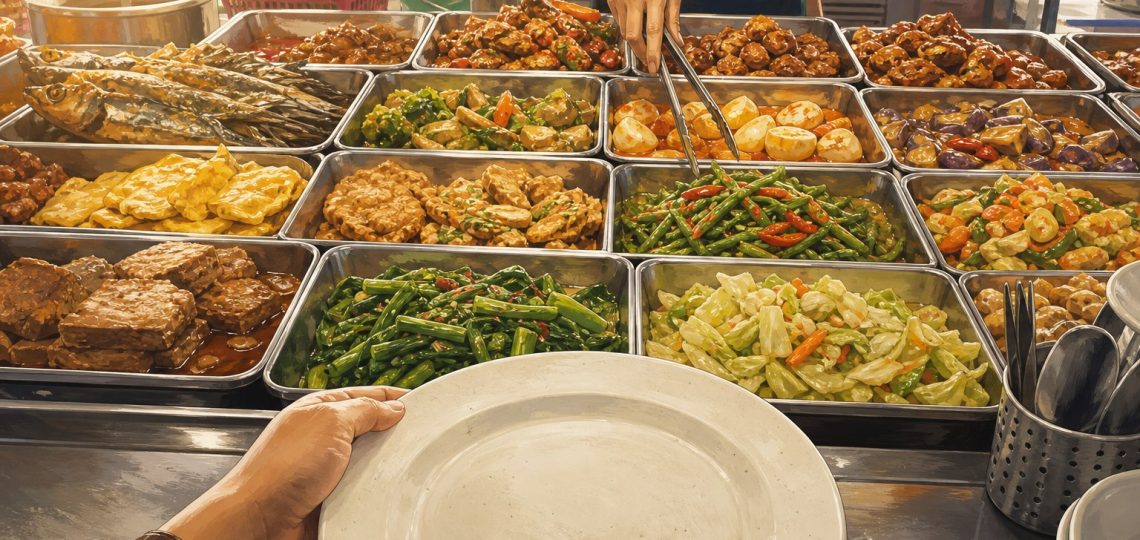
Nasi Campur, Nasi Kandar or Economy Rice? Read the Counter Before You Order
Three Malaysian meal labels can lead to a similar-looking counter: rice, trays of cooked dishes and a plate assembled by choice. The overlap is real, but the names are not interchangeable cuisine labels.
The practical way to distinguish them is to read both the food tradition and the ordering system.
Counter comparison
| Label | Useful starting definition | What to look for | What to ask |
|---|---|---|---|
| Nasi campur | A broad “mixed rice” format: rice with selected prepared dishes | The restaurant’s regional or cultural cooking identity | “Do I choose the dishes myself?” |
| Nasi kandar | An Indian Muslim rice tradition strongly associated with Penang, served with curries and chosen dishes | Curry combinations, prepared proteins and the server’s plating flow | “Which curry is this?” and “How is the plate priced?” |
| Economy rice | A common English label for a Chinese-style mixed-rice counter, also called cai fan in some contexts | Self-selection or pointing among vegetable, tofu, egg, meat and fish dishes | “Do I pay after choosing?” |
This is a recognition tool, not a nationwide pricing standard. A restaurant may use a familiar label while changing the service flow, and menus may use more than one language.
The plate is a set of decisions
First decide how much rice you want. Then scan the whole counter before selecting dishes. Build contrast—perhaps one vegetable, one protein and one sauced item—instead of choosing several dishes that look different but carry similar gravies.
If prices are not itemised, ask before loading the plate. Seafood, larger proteins and premium dishes may be counted differently from vegetables or eggs. Photographing a stranger’s plate and asking for “the same” can still produce a different price because portion and dish category matter.
Why nasi kandar creates extra confusion
Recent Malaysian food-community questions from visiting diners ask both where to try nasi kandar and how its array of dishes works. That suggests the obstacle is not awareness of the name; it is entering a busy counter without knowing what can be combined.
Tourism Malaysia describes nasi kandar among the country’s notable foods and connects it with Penang’s Indian Muslim food culture. The generous mixing of curries is a recognizable attraction, but the exact combination is still a choice. Ask for a little of a curry first if you do not know its heat or flavour.
“Mixed rice” names describe families, not one template
Nasi campur can cover meals shaped by Malay, Indonesian and regional Malaysian repertoires. “Economy rice” commonly points toward a Chinese mixed-rice setting. Those associations help you predict the counter, but they do not certify ingredients, dietary suitability or ownership.
Use the displayed menu, the operator’s explanation and any official certification relevant to your needs. Visual resemblance is not evidence that two trays contain the same ingredients.
Compare the staged service of banana leaf rice or use this counter map while exploring a Malaysian pasar malam.
Sources and limits
The food-tradition baseline is drawn from Tourism Malaysia’s Malaysian food reference and Malaysian breakfast overview. The visitor problem appears in a 2026 couple’s question about Malaysian mixed-rice foods and a 2026 first-timer request about nasi kandar. Community posts identify questions and individual experiences, not universal rules.