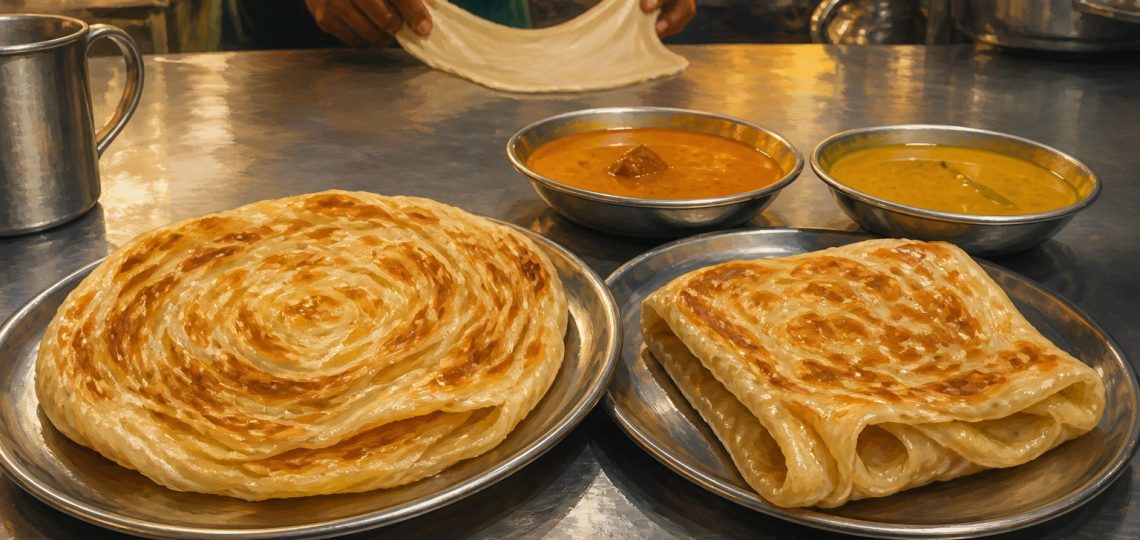
Roti Canai Menu Decoder: From Kosong to Tissue
At a mamak, “roti” is only the start of the order. The word that follows often tells you whether the flatbread is plain, filled, sweet, crisp or served under gravy.
That modular naming system is why a counter with no obvious English menu can still offer dozens of combinations. It is also why memorizing one giant list is less useful than learning the pattern.
Start with the modifier
| Order name | What the modifier usually signals | What can still vary |
|---|---|---|
| Roti kosong | Plain, without a filling | Size, crispness and accompanying gravies |
| Roti telur | Egg inside the folded bread | Number of eggs and seasoning |
| Roti bawang | Onion filling | Type and amount of onion |
| Roti telur bawang | Egg and onion | Restaurant preparation |
| Roti pisang | Banana filling; commonly sweet | Added sugar or condensed milk |
| Roti planta | A sweet, rich variation associated with margarine | Brand and sweetness |
| Roti tissue / tisu | Very thin and crisp, often sweet and dramatically shaped | Height, toppings and serving form |
Tourism Malaysia describes roti kosong as the original no-filling form and lists fillings ranging from egg and banana to meat. Its wider Malaysian food reference describes roti tissue as a thinner, crispier sweet spin on roti canai. The table stops there deliberately: creative names are often restaurant inventions, so a local menu remains the controlling source.
Gravy words change the final experience
The bread and the gravy treatment are separate choices. Kuah means gravy or sauce. In community ordering discussions, kuah campur is used for a mixture of gravies, while banjir evokes a bread or rice dish flooded with gravy.
Because usage varies, a first-timer can use a more explicit request:
- “Gravy on the side, please.”
- “A little dhal and curry.”
- “Which gravies come with this?”
If you want to keep the bread crisp, order gravy on the side. If you want it soaked, ask whether the restaurant uses banjir for that style rather than assuming every counter interprets the word identically.
Build an order in three decisions
First choose texture and filling: plain, egg, onion, banana or a crisp sweet form. Next choose the gravy arrangement: side, mixed or poured over. Finally choose a drink.
A low-risk first order is one roti kosong with gravy on the side. It lets you taste the bread and each sauce separately. A second order can then test a filling or texture you noticed at another table.
This progression also prevents an easy mistake: ordering several unfamiliar sweet and savoury variants at once because their names sound like small differences. A towering roti tissue is a different eating experience from a soft roti telur under curry.
The name-origin trap
Online discussions repeatedly debate whether canai refers to Chennai, a technique or another route of transmission. The same discussions often mix documented language with attractive origin stories. This guide does not settle that history because an ordering article does not need an uncertain etymology to be useful.
For the current Malay meaning of a word, consult DBP; for the history of a food, require dated historical sources rather than treating a popular explanation as fact.
What to watch while you wait
Tourism Malaysia points to the preparation itself as part of the appeal: dough is stretched and tossed before cooking on a griddle. Watch how folding creates layers and how a thin crisp order is shaped differently. That visible process is a better cultural clue than a generic claim that roti is “iconic.”
Use the Mamak versus Kopitiam comparison to choose the venue, and browse more menu-reading guides in Malaysian Food & Drink.
Sources and limits
Core forms come from Tourism Malaysia’s breakfast guide and Malaysian food reference. Traveler interest and variant language were checked against a Malaysian roti canai discussion. Community terms are reported usage, not a standardized national menu. Almean did not order or taste these dishes.