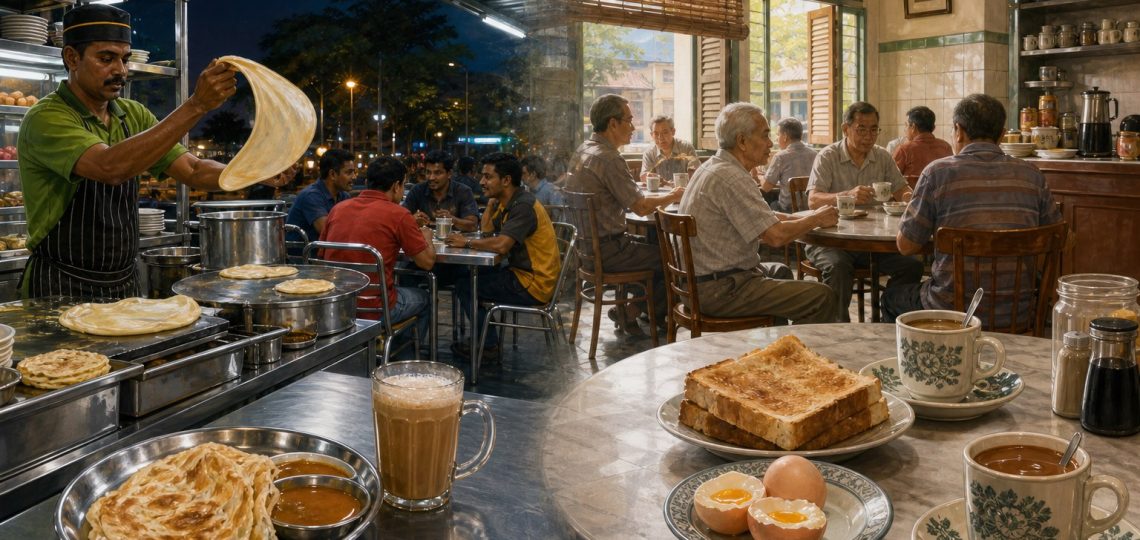
Mamak or Kopitiam? How to Choose Your Malaysian Food Stop
Choose a mamak when the draw is Indian-Muslim food, roti canai, teh tarik and a casual place to sit. Choose a kopitiam when the draw is the traditional coffee-shop format, local coffee, toast or several stalls operating around a shared seating area. Then check the actual sign, menu and operating hours, because neither label guarantees every feature.
The interesting difference is not which one is “better.” It is how two everyday venues organize food and social time differently.
A venue-choice matrix
| What you want | Mamak is the stronger first guess | Kopitiam is the stronger first guess | Verify before assuming |
|---|---|---|---|
| Roti canai, dhal or teh tarik | Yes | Sometimes available through a stall, but not defining | Current menu |
| Kaya toast, soft-boiled eggs and traditional kopi | Sometimes | Common association | Each shop’s breakfast menu |
| One operator and a broad cooked-to-order menu | Common format | Some modern kopitiams use this model | Who takes the order |
| Several independent food stalls around shared tables | Possible in adjacent food courts | Common in some traditional coffee shops | Whether stalls bill separately |
| A late-night place to sit and talk | Frequently associated with mamak culture | Some stay late, many do not | Posted opening hours |
| Halal assurance | Do not infer certification from a casual label alone | Do not infer suitability from the English name alone | Displayed certification, menu and staff |
Tourism Malaysia identifies roti canai with local Indian tea stalls known as mamak stalls and describes the mamak as a favourite place for both food and hanging out. Its Kuala Lumpur travel material describes kopitiams as traditional coffee shops. Those descriptions establish useful starting points, not a licensing system for the words.
Why “mamak” can describe more than a menu
A 2025 Malaysian discussion asked why groups repeatedly end up at mamak stalls for supper, football, gossip or teh tarik. Replies emphasized availability, service and the ability to stay and talk, but they were personal reports and sometimes contradicted one another. The thread is valuable because it reveals the user question: visitors are trying to understand why a restaurant category also behaves like a social room.
That social role does not make every mamak a 24-hour venue, equally busy or suitable for a long stay. Read the room. A crowded table needed by waiting diners is different from a quiet late-night restaurant.
Why a kopitiam may feel like several restaurants at once
In one common layout, the drinks operator manages the room while independent stalls sell noodles, rice or other dishes. A newcomer may order food from one stall, a drink from another and receive separate bills at the same table.
Other businesses use “kopitiam” as a brand or design language while operating as a single modern restaurant. That is why décor alone is not enough. Look for stall signs, separate counters and whether staff ask for a table number.
If the venue has many independent stalls under one roof but no coffee-shop operator, “hawker centre” or “food court” may be the clearer description. See how ordering works at a Malaysian hawker centre before your first visit.
Three quick scenarios
You want to watch dough being stretched and order a crisp flatbread: start with a mamak and use the Roti Canai menu decoder.
You want local coffee with toast and eggs in the morning: start with a kopitiam, then use our Malaysian kopi order decoder to separate milk, sweetness and temperature without importing Singapore terminology unchanged.
You want the widest possible choice for a mixed group: inspect a multi-stall kopitiam or hawker centre. Confirm dietary needs stall by stall; shared seating does not make every kitchen identical.
Sources and limits
The venue definitions use Tourism Malaysia’s breakfast guide and its Kuala Lumpur eating guide. The social question comes from the 2025 mamak discussion. Community comments inform questions and exceptions, not nationwide frequency. Almean did not inspect a venue for this article.