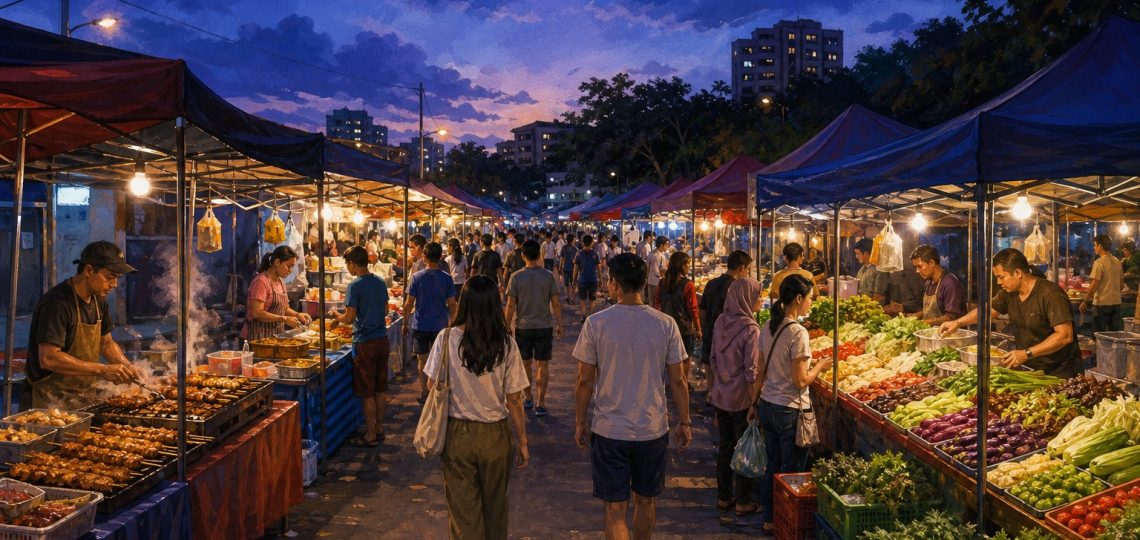
Malaysia Pasar Malam for First-Timers: How to Read a Moving Night Market
A Malaysian pasar malam is better understood as a market appointment than a permanent attraction. The same road may be ordinary by day and become a dense line of food, produce, clothes and household stalls on one scheduled evening.
That moving schedule is the first-timer’s main trap. Searching “night market near me” may surface a tourist street that opens often, a weekly neighbourhood market, or an old listing whose day has changed.
Verify the market in three dimensions
| Check | Question to answer | Why it matters |
|---|---|---|
| Day | Does this market operate on this weekday? | Many neighbourhood markets are tied to a particular evening |
| Place | What is the current street or landmark? | Road closures and stall lines may not match a map pin |
| Type | Weekly local market, permanent food street or seasonal event? | The products, crowd and operating pattern can differ |
Confirm all three with a current local authority, market operator, hotel or recent venue notice. A general tourism article is useful for ideas but should not override same-day information.
Walk once before buying everything
Start with a reconnaissance lap if the market is manageable. Notice where cooked food begins, where drinks are sold and whether there is any seating. This prevents buying a hot dish at the entrance and carrying it through the entire crowd while discovering a better fit later.
Use the first lap to compare portion sizes and preparation. A queue can signal popularity, but it does not prove that a dish suits your dietary needs. Ask the vendor directly about ingredients; a shared market does not imply shared kitchen practices or certification.
Read the market as local infrastructure
Tourism Malaysia’s Kota Bharu guide points visitors toward night-market activity alongside the city’s food culture. That example is useful because a pasar malam is not only an outdoor tasting menu. Produce, clothing and household goods show who the market serves and how it fits into neighbourhood routines.
The most interesting observation may therefore be a pairing: a regional snack beside an everyday grocery stall, or a modern drink beside traditional prepared food. Record the item name from the sign before inventing a history for it. If you want to write or share the visit, a name, location and vendor explanation are more valuable than “mysterious local food.”
A compact first-visit route
Arrive early enough to orient yourself, but expect some stalls still to be setting up. Carry small, flexible payment options without assuming every vendor is cash-only. Bring a small bag, protect food from rain and crowds, and use the disposal facilities provided.
Choose one item you can identify, one item you can ask about and one non-food detail to observe. That gives the visit variety without turning it into a volume challenge.
For multi-stall ordering mechanics, use the hawker-centre ordering guide. If the market uses rice-and-dish counters, compare nasi campur, nasi kandar and economy rice.
Sources and limits
Destination context comes from Tourism Malaysia’s Kota Bharu local guide and its 2026 Malaysia market guide. Repeated date-and-location confusion appears in traveller questions about Kuala Lumpur pasar malam and Malaysian night markets. Schedules change; verify locally before travelling.