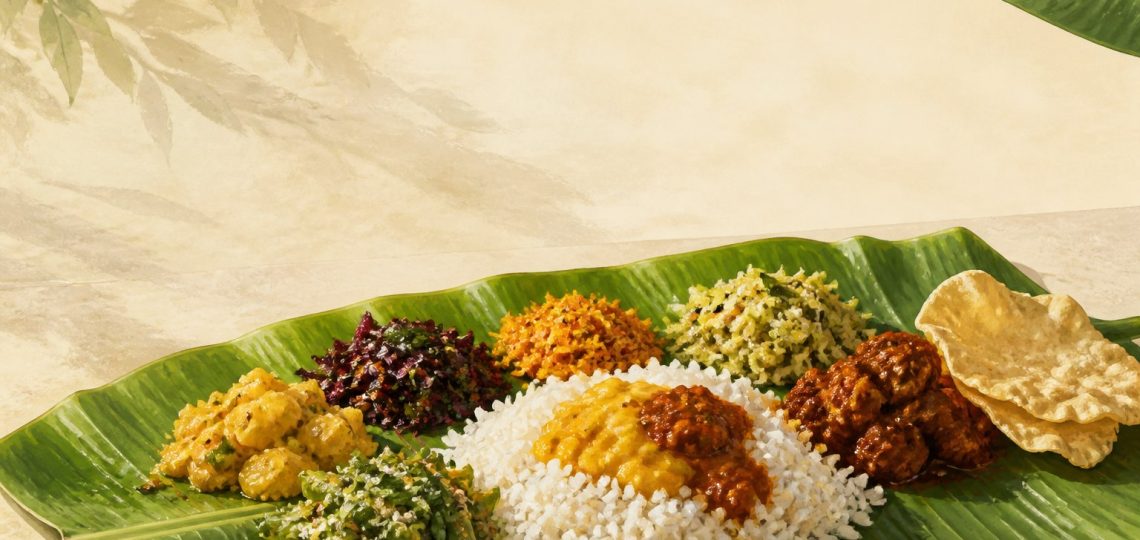
Banana Leaf Rice for First-Timers: What Arrives and What to Do
Your banana leaf is not a decorative placemat. It is the plate, and the meal usually arrives in stages: rice, vegetable sides, gravies and optional dishes rather than one finished composition from the kitchen.
That sequence is what confuses first-timers. In one Malaysian community question, a diner could describe two small servings by colour and taste but did not know whether they were meant to be drunk or mixed with rice. The discussion identified possibilities such as rasam, raita and buttermilk, while also showing why appearance alone is a poor identification method. The useful move is not to bluff. Point and ask, “What is this one?”
Read the meal as four layers
| Layer | What may arrive | What to decide | Useful question |
|---|---|---|---|
| Base | Rice on the leaf | Start with the amount offered or ask for less | “Less rice, please” |
| Vegetable set | Several cooked vegetables and sometimes a crisp accompaniment | Try each separately before mixing everything | “Are these included?” |
| Gravies and condiments | Dhal, curry, rasam or other restaurant-specific choices | Add a little first; more is easier than undoing a flooded plate | “Which one is mild?” |
| Extras | Chicken, fish, mutton, squid or other à-la-carte dishes | Confirm whether an item is included and whether it is priced separately | “How much is this extra?” |
This is an orientation map, not a promise that every restaurant serves the same set. Tourism Malaysia describes banana leaf rice as rice accompanied by curries, vegetables and condiments, but actual combinations belong to the restaurant and can change by day.
What to do in the first five minutes
Let the server place the standard components before committing to extras. Watch whether additional dishes are offered from a tray or ordered from a menu. If the price is not displayed, ask before accepting a premium-looking protein or seafood dish.
Next, taste the gravies separately. A small amount on one section of rice lets you understand the flavour without turning the whole leaf into one mixture. You can combine more later if that is how you enjoy the meal.
Finally, ask about refills. A Kuala Lumpur Tripadvisor discussion shows why the distinction matters: one contributor described restaurants where rice and vegetables were refillable but à-la-carte meat or seafood was separate, and where each diner was expected to order a meal rather than share one refillable base. That is a report about a restaurant format, not a universal Malaysian rule. The safe question is, “Are rice and vegetables refillable here?”
Hands, cutlery and the right question
Eating with the right hand is familiar in many Malay and Indian dining contexts, but visitors are not required to perform expertise they do not have. Tourism Perak’s dining guide notes both hand eating and the widespread use of fork and spoon. If cutlery is not already on the table, ask for it.
If you do eat by hand, use the handwashing facility provided and follow the restaurant’s visible setup. Avoid turning a personal preference into a claim that one method is more authentic. A meal can be culturally meaningful without making a guest pass an etiquette test.
The small bowls are clues, not labels
The Reddit question about a sour liquid and a white yoghurt-like side is a useful case because respondents proposed more than one possibility. Rasam can be mixed with rice or consumed separately; a white preparation might be raita or a thinner buttermilk preparation. The exact answer depends on what the restaurant served.
Use three observations when asking: colour, texture and whether it contains visible vegetables. Those details help staff identify the item without requiring you to know its name in advance.
A first-timer order that leaves room to learn
Start with one standard banana leaf meal per diner. Add one shared dish only after confirming the restaurant permits that arrangement, then keep the first round of gravy light. This creates a tasting sequence instead of a plate where every flavour is combined before you recognize it.
For another counter-style meal where names matter, see Nasi Campur, Nasi Kandar and Economy Rice compared. Browse more practical food culture in Malaysian Food & Drink.
Sources and limits
The meal structure is based on Tourism Malaysia’s banana leaf rice overview. The recurring questions come from a Tripadvisor dining-etiquette discussion and a Malaysian community question about banana leaf components. Community answers are treated as reported practice, not nationwide rules. Almean did not visit or test a restaurant for this guide.