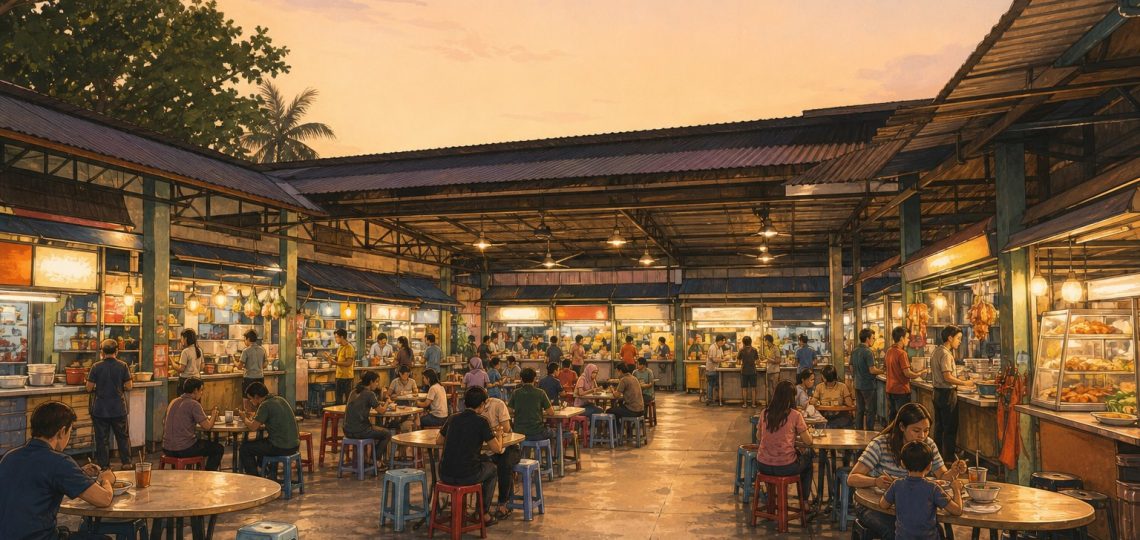
How to Order at a Malaysian Hawker Centre Without Guessing
The simplest hawker-centre rule is: identify your table, identify the stall, and confirm when to pay. Everything else depends on the venue.
A first-timer may expect one menu and one bill because all the tables share a roof. In many Malaysian hawker settings, however, independent stalls prepare different dishes and may take payment separately. The shared table connects the meal, not necessarily the businesses.
The six-step order flow
| Step | What to do | Checkpoint |
|---|---|---|
| 1. Read the entrance | Look for signs about seating, tray return or restricted outside food | Follow venue instructions before copying another table |
| 2. Find a table | Note its number or another clear location marker | Photograph the number for your own reference if necessary |
| 3. Choose a stall | Read the stall’s menu and queue pattern | Do not assume the next stall shares its payment system |
| 4. Place the order | Give the dish, options and table number | Ask whether food will be delivered or collected |
| 5. Confirm payment | Pay now if asked; otherwise ask whether payment is at delivery | Keep small payment methods available without assuming cash-only |
| 6. Order drinks separately | Look for a drinks counter or roaming server | Confirm whether the drink belongs to the venue or one stall |
This flow is deliberately conditional. Some food courts use central cashiers or stored-value systems. Some hawker centres expect collection. Some stalls bring food to the table and collect payment there.
The table number is a routing instruction
A Tripadvisor first-timer guide to Penang hawker food described ordering from different stalls and giving the same table number to each. That is a useful documented example because it explains how one table can assemble a meal from several kitchens.
If there is no visible number, use a landmark: “the table beside the red pillar,” then point. Avoid relying on gestures alone in a crowded room. Ask the stall to repeat the location if you are unsure.
An editorial practice line might be: “One char koay teow, table 18. Pay now or at the table?” It is not a guaranteed local script; it simply bundles the three facts the vendor needs.
Hawker centre, food court and kopitiam are not perfect synonyms
A hawker centre generally emphasizes multiple food stalls and shared seating. Food court can describe a similar arrangement, often in a managed indoor venue. A traditional kopitiam may combine a drinks operator, shared tables and independent stalls, while a modern kopitiam brand may work as a single restaurant.
Names on maps are inconsistent, so behavior matters more than the English category. Count the counters, observe who clears tables and ask who takes the drink order. For a venue-level comparison, see Mamak or Kopitiam?
Three mistakes the flow prevents
Do not carry one stall’s dish to another stall and assume it is a combined queue. Do not walk away without confirming whether you paid. And do not leave staff searching for a table number you forgot to give.
Dietary requirements also belong at stall level. Shared tables and a common roof do not prove that kitchens use the same ingredients, certification or equipment. Ask the individual operator and rely on displayed information.
What makes this more than a food list
Tourism Malaysia describes hawker stalls as a familiar part of places such as Petaling Street, but a destination list does not explain the choreography. The reusable insight is the routing system: table, stall, delivery and payment. Once that is clear, a visitor can explore dishes without pretending to know every menu term.
Browse more practical meal formats in Malaysian Food & Drink and use Tapau versus Bungkus when you want the food packed to take away.
Sources and limits
Venue context comes from Tourism Malaysia’s Petaling Street guide. The ordering problem and table-number example were identified in a Penang hawker guide for first-timers and a Kuala Lumpur hawker-tips discussion. These are community reports, not universal operating rules. Almean did not test a venue.