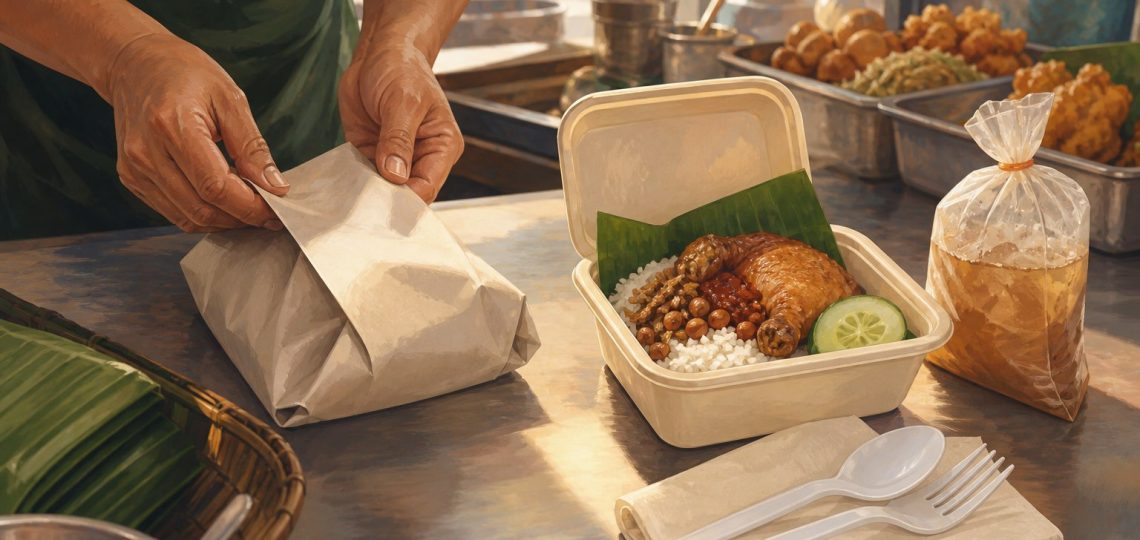
Tapau vs Bungkus in Malaysia: Which Word Should You Use?
If you want food to go in Malaysia, both tapau and bungkus can get the job done. The useful difference is not a rigid rule about which word is “correct.” It is the job each word is doing in the conversation.
Bungkus is the Malay word connected with wrapping or packing. Tapau is widely used as an informal Malaysian term for packing food to take away; Malaysia’s Dewan Bahasa dan Pustaka records that colloquial meaning. At a food stall, either may be understood from context.
A two-word takeaway card
| What you want | Short phrase | What it communicates |
|---|---|---|
| Order new food to go | “Bungkus, please” | Pack this order instead of serving it for dining in |
| Use the common colloquial term | “Tapau, please” | Make or pack the order for takeaway |
| Pack unfinished food | “Can tapau this?” | Put the remaining food into a takeaway container |
| Remove any ambiguity | “Take away, please—not eating here” | State the result rather than relying on local vocabulary |
These are practical prompts, not a phrasebook of mandatory grammar. Staff may answer in Malay, English, Mandarin, Tamil or a mixture, and local preference can differ.
Why travellers meet both words
A Kuala Lumpur dining-etiquette discussion included a visitor asking how to request that leftovers be packed. A separate Malaysian forum discussion asked whether tapau and bungkus were interchangeable. Together, those questions reveal the real search intent: people are not studying a dictionary distinction; they want to avoid accidentally ordering dine-in food.
The safest moment to say the word is while ordering, before the food is plated. Point to the item and say “tapau” or “bungkus.” If you are packing leftovers, point to the dishes that should be included and keep separate any items you do not want packed.
The container question matters more than the vocabulary
Knowing the word does not tell you how a particular business packages soup, drinks or several dishes. A stall may separate gravy, use its standard container or charge according to its displayed policy. Ask a concrete follow-up:
- “Can the gravy be separate?”
- “One pack or two?”
- “Is the container included?”
Those questions solve the transaction without pretending that one national packaging system exists.
Do not turn slang into a cultural test
Using tapau can sound natural in everyday Malaysian speech, but visitors do not need to imitate an accent or add particles to prove familiarity. Clear English plus a gesture is usually more respectful than a memorised phrase delivered with false confidence.
The reverse is also true: hearing bungkus does not mean the speaker is being formal. It is an ordinary useful verb with a wider meaning than restaurant takeaway. Context supplies the food-ordering sense.
For the steps before takeaway, use the Malaysian hawker-centre ordering flow. For another context-dependent Malaysian expression, read What Does “Lah” Mean?.
Sources and limits
The lexical distinction is based on Dewan Bahasa dan Pustaka’s record for tapau and its standard Malay treatment of bungkus. The recurring visitor question was identified in a Tripadvisor dining discussion and a Malaysian forum thread. Forum comments show individual usage, not a nationwide rule. Almean did not test a restaurant for this guide.