Why Are Spoon and Fork Common in Malaysia? The Table Logic Explained
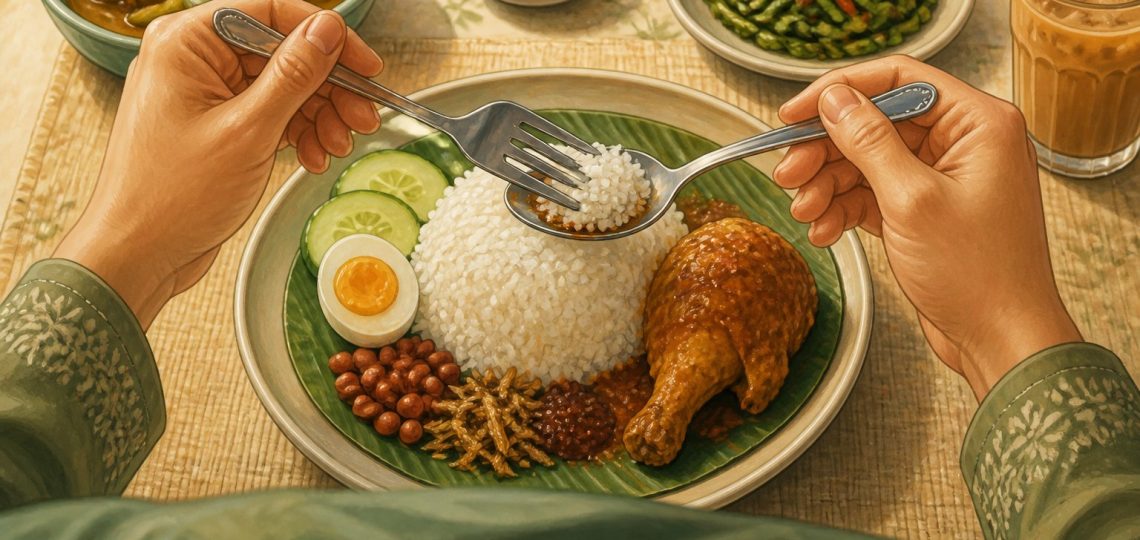
At many Malaysian tables, the spoon is the main eating tool and the fork is its assistant. The fork gathers rice and small pieces onto the spoon; the spoon carries the bite and handles gravy.
That division of labour makes sense for meals built around rice, several dishes and sauces. It also explains why treating the fork as the only “Western” default can feel awkward: loose rice escapes the tines, while a spoon holds rice and curry together.
The utensil-job matrix
| Food situation | Commonly useful tool | Why it works | Other likely option |
|---|---|---|---|
| Rice with curry or several dishes | Spoon in the right hand, fork assisting | The spoon contains grains and sauce | Eating with the right hand in an appropriate setting |
| Noodles | Chopsticks, fork or spoon-and-fork depending on dish and venue | The noodle shape and broth change the task | Follow what the stall provides |
| Soup | Spoon | Carries liquid and ingredients together | A venue may provide a Chinese-style soup spoon |
| Shared dishes | Serving utensils | Keeps personal utensils out of communal plates | Ask if a serving spoon is missing |
| Banana leaf meal | Right hand or spoon-and-fork | Both can manage rice and gravies | Choose the method the venue supports and you can use comfortably |
The matrix describes practical patterns, not ethnic rules. Malaysia’s multilingual food landscape includes many overlapping utensil traditions, and a single table may offer several.
How to use the pair
Hold the spoon in your right hand and the fork in your left if that arrangement is comfortable. Use the fork to guide a manageable amount of rice and food onto the spoon. There is no need to cut every soft item with the side of the spoon; larger or tougher pieces may require an appropriate utensil supplied by the restaurant.
If the place sets the utensils differently, follow the setup. The goal is not to demonstrate a national technique but to eat neatly and avoid moving shared serving utensils onto your own plate.
Why visitors ask about the “correct” hand
Traveller etiquette discussions often compress several practices into one question: Is the left hand forbidden? Must everyone eat with their fingers? The more accurate answer separates contexts.
Tourism Perak’s dining guide describes both eating with the fingers of the right hand and the common fork-and-spoon arrangement. Religious and social meanings can influence hand use, especially when food is eaten directly by hand. With cutlery, observe the table and avoid making dramatic claims about another diner’s choice.
Etiquette is not an authenticity contest
Ask for cutlery if you need it. Do not imitate hand eating unless you can do so hygienically and the venue supports it. Conversely, do not describe eating by hand as a lack of utensils; it is a skilled and meaningful method in many dining traditions.
For a meal where both methods may appear, read the banana leaf rice first-timer guide. For a social invitation where the host’s setup matters, see the Malaysian open-house guest guide.
Sources and limits
The dining-practice baseline comes from Tourism Perak’s Beli-Belah dining and shopping booklet. The recurring visitor concern is represented by a Tripadvisor Malaysia etiquette discussion. Forum posts are used to identify questions, not to define every Malaysian household or community.