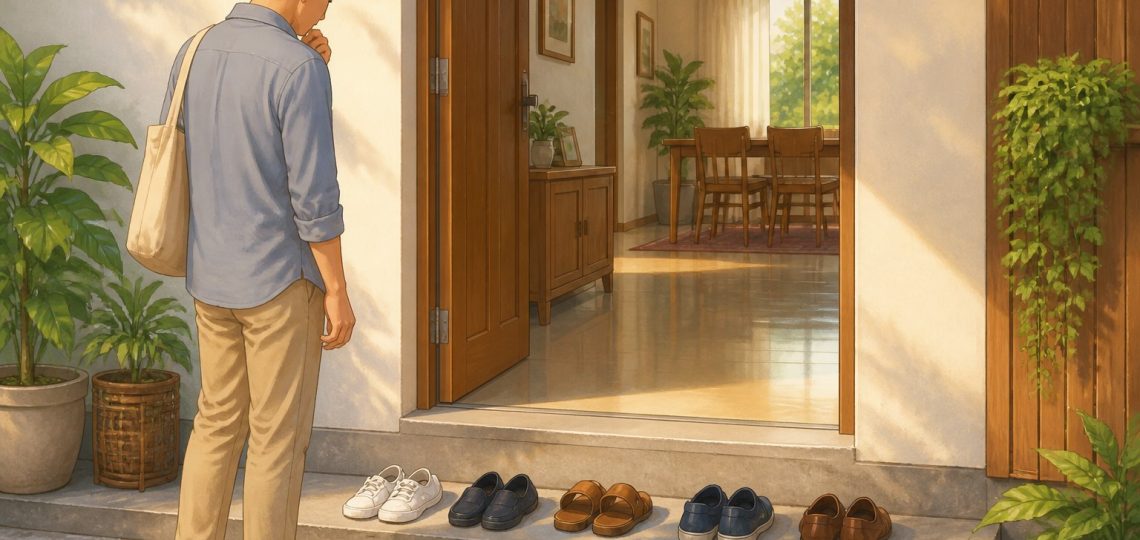
When Should You Remove Your Shoes in Malaysia? Follow These Entrance Cues
The most reliable Malaysian shoe rule is visible at the doorway: look for a sign, a shoe rack, a line where flooring changes, or what the host and worshippers are doing.
Visitors often ask for one national rule, but the setting matters. Shoes are normally removed before entering prayer areas of mosques, and many homes and other religious spaces also expect removal. Public galleries, offices, shops and the outdoor grounds of a complex may follow different rules.
The entrance-cue ladder
| Cue | Likely action | Best response if uncertain |
|---|---|---|
| “Remove footwear” sign or staff instruction | Remove shoes at the indicated boundary | Ask where to leave or carry them |
| Shoe racks or many neatly placed shoes | Pause before crossing the same boundary | “Shoes off here?” |
| Host removes shoes at a home entrance | Follow the host unless told otherwise | Wait for a gesture or ask |
| Worshippers are barefoot beyond a marked line | Treat the line as the footwear boundary | Confirm with an attendant |
| No cue in a public reception or museum area | Do not invent a rule | Continue until signage or staff says otherwise |
This ladder is more useful than memorising a list of building types because large religious complexes can contain outdoor, visitor and prayer zones with different boundaries.
A mosque question reveals the real problem
In a Tripadvisor question about Kuala Lumpur, a visitor knew shoes would need to come off but worried about leaving them outside and asked whether they could be carried in a bag. The question is practical, not theological: where is the transition point, and what happens to the footwear?
At a staffed site, ask the attendant. Some places provide racks, bags, robes or visitor directions; the available system belongs to that site. Tourism Malaysia’s Putra Mosque visitor information also notes that visitors should dress respectfully and follow the mosque’s visitor requirements. Check current signs when you arrive rather than relying on a photograph from an old review.
Homes: watch before you step
At a private home, stop at the entrance instead of walking in while asking. A cluster of footwear is a strong cue, but the host’s instruction is decisive. Socks are generally less disruptive than debating the custom in the doorway; if accessibility or medical needs affect footwear, explain quietly and let the host suggest an arrangement.
Do not describe shoe removal as proof that every Malaysian household shares one religion or ethnicity. It can be a religious requirement in one setting, a household cleanliness preference in another, or simply the host’s established practice.
Carry a small practical kit
Wear footwear that is easy to remove, keep socks presentable and carry a reusable bag in case a site asks visitors to keep shoes with them. The bag is a contingency, not permission to carry footwear into any prayer space. Follow local instructions.
If you are visiting a home for a celebration, pair this with the Malaysian open-house guest guide. Browse more situational guidance in Malaysian Customs & Etiquette.
Sources and limits
Site-specific visitor context comes from Tourism Malaysia’s Putra Mosque guide. The recurring practical concern comes from a traveller question about carrying shoes at a mosque. The forum question demonstrates uncertainty, not a rule for every site. Always follow posted and staff instructions at the place you visit.