Ultimate Global Cultural Travel Guide: Top Heritage Sites
The Essence of Global Cultural Heritage Travel
Cultural heritage travel transcends the boundaries of traditional tourism. It is a profound exploration into the architectural, spiritual, and historical frameworks that have shaped human civilization. By visiting preserved palaces, ancient ruins, and enduring places of worship, travelers engage in a tactile dialogue with history. This guide meticulously synthesizes the core experiences of eight diverse global destinations, offering an unprecedented deep dive into the cultural intersections of Asia, Africa, South America, and Europe. Each location presents a unique narrative of conquest, resilience, spiritual devotion, and artistic triumph.
Understanding the historical context of these sites is paramount to fully appreciating their significance. Whether it is the intricate wooden joinery of East Asian temples, the formidable stone masonry of the Andes, or the geometric perfection of Islamic architecture, these physical structures are the ultimate manifestations of the societies that built them. We will explore not only the grand facades but also the hidden courtyards, the socio-political climates of their respective eras, and the modern preservation efforts required to maintain their integrity for future generations.
The Transformative Power of Immersive Exploration
To truly absorb the essence of these global landmarks, one must move beyond the superficial act of sightseeing. Immersive exploration requires a strategic approach to travel, encompassing an understanding of local customs, architectural symbolism, and historical timelines. By delving into the specific case studies of these eight extraordinary regions, we unlock a richer, more nuanced worldview.
- Architectural Literacy: Recognizing the structural innovations and decorative motifs that define specific eras, such as the colorful Dancheong painting in Korea or the intricate zellige tilework in Morocco.
- Historical Empathy: Understanding the human stories embedded within these sites, from the political prisoners of Robben Island to the royal intrigues of the Joseon Dynasty.
- Cultural Synchronization: Participating in local traditions, such as traditional tea ceremonies or navigating bustling historical marketplaces, to bridge the gap between the past and the present.
Armed with this foundational mindset, let us embark on a detailed dissection of the world’s most captivating cultural heritage destinations.

Seoul’s Royal Legacy: Gyeongbokgung and Changdeokgung Palaces
In the heart of South Korea’s hyper-modern capital lies a meticulously preserved testament to the Joseon Dynasty (1392–1897). Gyeongbokgung and Changdeokgung are not merely historical relics; they are active cultural epicenters that showcase the pinnacle of traditional Korean architecture, statecraft, and philosophical alignment with nature. These palaces serve as the ultimate entry point for understanding the Confucian ideals that governed Korean society for over five centuries.
Gyeongbokgung: The Northern Palace of Radiant Brilliance
Constructed in 1395, Gyeongbokgung was the primary royal residence and the administrative heart of the Joseon Dynasty. Its layout is a masterclass in geomancy (pungsu-jiri), strategically positioned with the protective Bugaksan Mountain to its rear and the flowing Cheonggyecheon Stream to its front. The palace complex is vast, characterized by imposing gates, expansive courtyards, and majestic throne halls.
The architectural hallmark of Gyeongbokgung is the Geunjeongjeon, the main throne hall where kings granted audiences, oversaw state affairs, and hosted foreign envoys. Elevated on a two-tiered stone platform, the hall features a sweeping, multi-bracketed wooden roof adorned with intricate Dancheong—a traditional Korean decorative coloring that utilizes five basic colors (blue, red, yellow, white, and black) to protect the wood from insects and the elements while symbolizing the cosmic forces.
- The Royal Guard Changing Ceremony: Taking place at Gwanghwamun Gate, this vibrant reenactment features guards in brilliant primary-colored uniforms wielding traditional weapons, offering a spectacular glimpse into Joseon-era military protocol.
- Gyeonghoeru Pavilion: A magnificent two-story structure seemingly floating on a rectangular artificial lotus pond, used historically for joyous state banquets and royal entertainment.
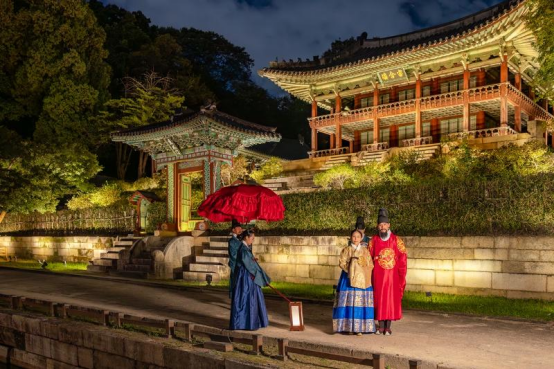
- Hanbok Integration: Modern visitors are encouraged to rent and wear traditional Hanbok garments, which grants free admission to the palace grounds and creates a visually stunning, immersive atmosphere.
Changdeokgung and the Secret Garden (Huwon)
While Gyeongbokgung represents imposing state authority, Changdeokgung (the Palace of Illustrious Virtue) embodies harmony with nature. Built in 1405 as a secondary palace, it became the primary royal residence for over 250 years after the Japanese invasions of the 1590s. Recognizing its exceptional organic design, UNESCO designated Changdeokgung a World Heritage site in 1997.
The absolute crown jewel of Changdeokgung is the Huwon, or Secret Garden. Comprising nearly 60% of the total palace grounds, this restricted area was the private sanctuary for the royal family. Unlike rigidly manicured European gardens, Huwon was designed to emphasize the natural topography. Pavilions, lotus pools, and ancient trees are seamlessly integrated into the rolling valleys. Access to the Secret Garden is strictly regulated, requiring advance reservations for guided tours to protect its delicate ecosystem.

The Soul of Morocco: Marrakech, Djemaa el-Fna, and Bahia Palace
Marrakech, the “Ochre City,” is a sensory masterpiece where Islamic architecture, Berber traditions, and centuries of trans-Saharan trade converge. At the core of its chaotic, vibrant energy is the ancient Medina, a labyrinth of narrow alleys, bustling souks, and hidden riads. Understanding Marrakech requires surrendering to its rhythm, navigating its historical squares, and uncovering the opulent palaces hidden behind unassuming clay walls.
Djemaa el-Fna: The Theater of Humanity
Djemaa el-Fna is the beating heart of Marrakech. By day, this massive open square is a bustling marketplace where snake charmers, henna tattoo artists, and fresh orange juice vendors compete for attention. However, as the sun sets, the square undergoes a dramatic metamorphosis. It transforms into an immense open-air dining area and a stage for traditional entertainment.
The nocturnal energy of Djemaa el-Fna is unparalleled. Storytellers (hlaykia) recite ancient myths, Gnawa musicians play hypnotic rhythms on their sintirs (three-stringed lutes), and acrobats perform daring feats. The air becomes thick with the smoke of grilled meats, cumin, and saffron emanating from dozens of pop-up food stalls. This intangible cultural heritage is so significant that UNESCO proclaimed it a Masterpiece of the Oral and Intangible Heritage of Humanity.
- Sensory Navigation: Visitors must embrace the chaos, engaging with vendors respectfully while maintaining awareness. The square is an exercise in negotiation and cultural immersion.
- Culinary Exploration: Do not miss the opportunity to taste traditional Moroccan street food, such as slow-roasted mechoui (lamb), steaming bowls of harira soup, and sweet mint tea poured from a height to create the perfect froth.
Bahia Palace: A Masterpiece of Moroccan Craftsmanship
In stark contrast to the frenetic energy of the square, the Bahia Palace offers a tranquil retreat into 19th-century Moroccan opulence. Built by Si Moussa, the grand vizier of the sultan, and later expanded by his son, the palace’s name translates to “The Brilliant.” It was designed to capture the essence of Islamic and Moroccan architectural styles, featuring over 150 rooms surrounding lush courtyard gardens.
The interior of the Bahia Palace is a testament to the unparalleled skill of Moroccan artisans. Every surface is a canvas for intricate decoration. The lower walls are adorned with zellige—geometric mosaic tilework that requires immense mathematical precision. Above the tiles, intricate stucco carvings feature delicate arabesques and Arabic calligraphy. The ceilings are masterpieces of zouaq—painted cedar wood featuring vibrant botanical motifs. The grand courtyard, paved in Carrara marble, exemplifies the inward-facing design of Islamic architecture, prioritizing privacy, shade, and inner beauty.

India’s Pink City: Jaipur’s Amber Fort and Palace of Winds
Jaipur, the capital of India’s Rajasthan state, is famously known as the “Pink City” due to the distinct terracotta-pink hue of its historic buildings—a color traditionally associated with hospitality, painted to welcome the Prince of Wales in 1876. Jaipur represents a brilliant fusion of Rajput military prowess and Mughal architectural elegance, offering a vivid window into the opulent lives of India’s historical maharajas.
Amber Fort: The Pinnacle of Rajput Architecture
Perched majestically on the rugged Aravalli Hills overlooking Maota Lake, the Amber Fort (Amer Fort) is a formidable complex constructed of pale yellow and pink sandstone, accented with white marble. Built primarily by Raja Man Singh I in the late 16th century, the fort is divided into four main courtyards, each serving a specific administrative or residential function.
The journey to the main entrance, Suraj Pol (Sun Gate), involves navigating a steep, winding path. Once inside, visitors are greeted by the Diwan-i-Aam (Hall of Public Audience), featuring a double row of columns topped with elephant-head capitals. However, the true masterpiece of Amber Fort is the Sheesh Mahal (Mirror Palace). The walls and ceiling of this exquisite pavilion are embedded with thousands of convex mirror fragments and colored glass. It is said that a single candle lit in the dark can illuminate the entire room, creating the illusion of a starry night sky.
- Strategic Design: The fort’s robust exterior walls and narrow defensive passages contrast sharply with the delicate, luxurious interiors, reflecting the dual necessity of military defense and royal comfort.
- Sukh Niwas (Hall of Pleasure): This ingenious structure features an early form of air conditioning, where water cascaded over channels cut into the marble walls, cooling the breeze that blew through the chambers.
Hawa Mahal: The Palace of Winds
Constructed in 1799 by Maharaja Sawai Pratap Singh, the Hawa Mahal is perhaps Jaipur’s most iconic landmark. Unlike a traditional palace, it is essentially a high screen wall built so the women of the royal household could observe street festivals and daily city life while remaining unseen from the outside, adhering to the strict rules of purdah.
The five-story exterior resembles the honeycomb of a beehive or the crown of Lord Krishna. It features 953 small windows, known as jharokhas, decorated with intricate latticework (jaali). This architectural marvel is not just aesthetically pleasing; it is scientifically brilliant. The Venturi effect created by the latticework forces air through the narrow openings, naturally cooling the interior even during the intense Rajasthani summers. The Hawa Mahal stands as a testament to the innovative intersection of social customs, aesthetics, and environmental engineering.

South Africa’s Complex History: Cape Town, Table Mountain, and Robben Island
Cape Town is a city defined by breathtaking topographical drama and profound historical gravity. Situated at the southern tip of the African continent, it is a place where unparalleled natural wonders serve as the backdrop for a complex narrative of colonization, racial segregation, and ultimate liberation. A journey to Cape Town requires an emotional and intellectual balance, navigating the awe-inspiring heights of its mountains and the somber depths of its political history.
Table Mountain: The Geological Masterpiece
Dominating the city’s skyline, Table Mountain is a flat-topped massif that is recognized as one of the New Seven Wonders of Nature. Its iconic plateau, stretching approximately three kilometers from end to end, is frequently draped in a dramatic orographic cloud formation known locally as the “Tablecloth.” The mountain is not merely a scenic backdrop; it is a biodiversity hotspot.
Part of the Cape Floral Region, Table Mountain is home to the fynbos biome. Despite its relatively small geographical footprint, this biome contains an astonishing diversity of plant species, many of which are endemic and found nowhere else on Earth. Visitors can ascend the mountain via the rotating Aerial Cableway, which provides 360-degree views of the city, the Atlantic seaboard, and the rugged Cape Peninsula.
- Ecological Significance: The mountain supports over 1,500 species of plants, outnumbering the plant diversity of the entire United Kingdom.
- Hiking Trails: For the adventurous, trails like Platteklip Gorge and Skeleton Gorge offer challenging ascents that reward hikers with intimate encounters with the unique flora and fauna, including the rock hyrax (dassie).
Robben Island: The Triumph of the Human Spirit
Just a short ferry ride across Table Bay lies Robben Island, a stark contrast to the natural splendor of the mainland. For nearly 400 years, this isolated outpost served variously as a leper colony, a mental hospital, and a military base. However, it is most infamous as the maximum-security prison where the apartheid regime incarcerated political prisoners, including Nelson Mandela, who spent 18 of his 27 years of imprisonment here.
Today, Robben Island is a UNESCO World Heritage site and a poignant museum. The tours are uniquely powerful because they are often guided by former political prisoners. These guides provide harrowing, firsthand accounts of the brutal conditions, the forced labor in the limestone quarry, and the unyielding solidarity among the inmates. Standing in Mandela’s tiny 8-by-7-foot cell, visitors are confronted with the harsh realities of institutionalized racism, but also the incredible resilience and capacity for forgiveness that birthed modern, democratic South Africa.

The Andean Crossroad: Cusco’s Blend of Inca and Spanish Culture
Nestled high in the Peruvian Andes at an elevation of nearly 3,400 meters (11,200 feet), Cusco is a city where two distinct civilizations violently collided and eventually fused. Once the navel of the vast Inca Empire (Tawantinsuyu), Cusco was conquered by Spanish conquistadors in the 16th century. Rather than completely destroying the city, the Spanish built their colonial churches and mansions directly upon the massive, mortarless stone foundations of the Inca palaces. The result is a striking architectural duality.
The Masterful Stonework of the Inca
The architectural prowess of the Incas is legendary, characterized by massive polygonal stones cut with such precision that not even a blade of grass can fit between them. This dry-stone technique, known as ashlar, was highly resilient to the frequent seismic activity in the region. When earthquakes struck, the Inca walls would “dance”—the stones interlocking and settling back into place—while the rigid Spanish structures built above them often collapsed.
The most famous example of this masonry is the Twelve-Angled Stone, located on Hatun Rumiyoc Street. This single block of diorite perfectly interlocks with all surrounding stones, demonstrating a level of engineering that continues to baffle modern scientists. The most sacred site in the Inca empire, the Qorikancha (Temple of the Sun), was once covered in solid gold plates. After the conquest, the Spanish looted the gold and constructed the Convent of Santo Domingo atop its foundations, creating a vivid, visual representation of cultural subjugation and endurance.
Colonial Grandeur and the Plaza de Armas
The heart of Cusco is the Plaza de Armas, a sprawling square flanked by colonial arcades and dominated by two magnificent religious structures: the Cusco Cathedral and the Church of the Society of Jesus (Iglesia de la Compañía de Jesús). The cathedral, built using stone transported from the nearby Inca fortress of Sacsayhuamán, is a masterpiece of Andean Baroque art.
- The Andean Last Supper: Inside the cathedral hangs a fascinating painting by Marcos Zapata depicting the Last Supper. In a brilliant example of religious syncretism, Jesus and his disciples are shown dining on a traditional Andean guinea pig (cuy) and drinking chicha (corn beer), illustrating how indigenous artists incorporated their own culture into imposed Catholic iconography.
- High-Altitude Adaptation: Visitors to Cusco must acclimatize to the extreme altitude. Traditional remedies, such as drinking mate de coca (coca leaf tea), are highly recommended to combat soroche (altitude sickness) before exploring the steep, cobblestone streets.

Singapore’s Cultural Mosaic: Merlion Park and Thian Hock Keng Temple
Singapore represents a remarkable narrative of rapid modernization built upon a foundation of diverse immigrant histories. It is a city-state where futuristic skyscrapers shadow centuries-old temples, and where Malay, Chinese, Indian, and British colonial influences seamlessly intertwine. To understand Singapore’s cultural landscape, one must examine both its modern mythological symbols and its authentic historical roots.
Merlion Park: The Modern Mythos
Overlooking the glittering Marina Bay, Merlion Park is home to Singapore’s most iconic symbol: the Merlion. This mythical creature, possessing the head of a lion and the body of a fish, was conceptualized in the 1960s as a tourism mascot, yet it perfectly encapsulates the nation’s identity. The fish body represents Singapore’s humble origins as a fishing village known as Temasek, while the lion head refers to its original name, Singapura, which translates to “Lion City” in Sanskrit.
The 8.6-meter-tall statue spouting water into the bay is surrounded by the architectural marvels of the 21st century, including the Marina Bay Sands and the Esplanade. It serves as a visual anchor point, representing Singapore’s transformation from a colonial trading post into a global financial powerhouse. The area is best experienced at dusk, when the city’s skyline illuminates the bay in a spectacular display of modern urban planning.
Thian Hock Keng Temple: The Hokkien Heritage
A stark contrast to the modern waterfront, the Thian Hock Keng Temple (Temple of Heavenly Happiness) in the Telok Ayer district offers a deep dive into Singapore’s immigrant past. Built in 1839, it is the oldest Chinese temple in Singapore, dedicated to Mazu, the Goddess of the Sea. Early Chinese immigrants, having survived the perilous journey across the South China Sea, would come here immediately upon arrival to offer thanks for their safe passage.
The temple is a masterclass in traditional southern Chinese architectural style. Remarkably, the entire original structure was constructed without the use of a single nail, relying instead on complex wooden joinery. The temple features sweeping, curved roof ridges decorated with intricate porcelain dragons, phoenixes, and floral motifs.
- Architectural Details: The heavy wooden doors are guarded by imposing painted deities, while the interior courtyards are filled with the heavy scent of burning incense coils hanging from the ceiling.
- Cultural Syncretism: Interestingly, the temple grounds also house shrines dedicated to Buddhist bodhisattvas and even a minor shrine to Confucius, reflecting the syncretic nature of traditional Chinese folk religion practiced by the early Hokkien pioneers.

Istanbul’s Architectural Marvel: The Millennium of Hagia Sophia
Straddling the Bosphorus Strait, Istanbul is the ultimate bridge between Europe and Asia. For over two millennia, it has served as the capital of the Roman, Byzantine, and Ottoman Empires. No single structure embodies the complex, layered history of this transcontinental metropolis quite like the Hagia Sophia (Ayasofya). Its massive dome has dominated the city’s skyline for nearly 1,500 years, bearing witness to shifting empires and changing faiths.
From Byzantine Basilica to Imperial Mosque
Commissioned by the Byzantine Emperor Justinian I and completed in 537 AD, the Hagia Sophia was designed to be the grandest church in all of Christendom. For nearly a thousand years, it held that title. The architectural genius of the structure lies in its massive central dome, which spans over 30 meters and seems to float on a halo of light created by the 40 arched windows at its base. This illusion was achieved through the pioneering use of pendentives—curved triangular vaults that transition the weight of the circular dome down to a square base.
In 1453, the Ottoman Empire, led by Sultan Mehmed the Conqueror, captured Constantinople. The Hagia Sophia was immediately converted into an imperial mosque. The Ottomans added four soaring minarets to the exterior, while the interior underwent significant alterations. A mihrab (prayer niche pointing to Mecca) and a minbar (pulpit) were installed, and massive wooden medallions bearing the names of Allah, the Prophet Muhammad, and the first four caliphs in exquisite Islamic calligraphy were suspended from the columns.
The Synthesis of Two World Religions
The true magic of the Hagia Sophia today is the visual juxtaposition of Christianity and Islam. When the building was secularized and turned into a museum in 1935 (before its recent reconversion to a mosque), plaster was painstakingly removed to reveal stunning Byzantine mosaics that had been